Some Catalans want nothing more than greater autonomy from Madrid; others want independence, full stop. But they all agree on one thing: Catalans are a distinct people. La Cotorra explains how Catalan identity was formed, why the idea of independence is still alive, and how realistic it is today.
Background
Catalonia is one of Spain’s 17 autonomous communities. Its northern border is the Pyrenees; to the east it is bounded by the Mediterranean coast; to the west lies the region of Aragon, and to the south-east, Valencia.
Catalonia covers 32,000 km² (sixth out of 17). Its population, as of 2024 is 8.1 million people (second only to Andalusia). Catalonia consists of four provinces: Barcelona, Girona, Tarragona and Lleida (Lérida). The capital is Barcelona, Spain’s second-largest city after Madrid. As of 2024, 1.7 million people live in Barcelona.
There is also the concept of the “Catalan lands”. It refers to the territory in which the Catalan language and Catalan culture are historically prevalent. Besides Catalonia itself, this includes the autonomous communities of Valencia and the Balearic Islands; the Franja (part of Aragon); El Carche (part of Murcia); the French department of Pyrénées-Orientales; Andorra; and the city of Alghero on Sardinia.
How did Catalonia emerge?
Catalan identity took shape over centuries — literally layer by layer. First, the eastern part of the Iberian Peninsula was home to Iberians; later came Phoenicians, Greeks, Carthaginians, Romans, and Visigoths. The mid-seventh century marked the rise of the Umayyad Caliphate. By 720, the whole territory of Catalonia had come under the rule of Arab-Berber conquerors.
However, Catalonia was not the main focus of Moorish power, and the neighbouring Frankish Empire took advantage of this. Frankish rulers began pushing the Moors back and granting the reconquered territories to their vassals. This gave rise to the Spanish March — a buffer zone between the Franks and the Arab domains, divided into counties dependent on the Carolingian monarchs. Barcelona became the capital of one of these counties (the County of Barcelona) and, more broadly, the centre of the Spanish March.
In 988, Count Borrell II, the ruler of Barcelona, refused to recognise the authority of the West Frankish king. Nationalists regard this as the birth of Catalan statehood.
The word “Catalonia” itself was first documented in the early twelfth century — in an oath sworn to the Count of Barcelona, Ramon Berenguer III. Its etymology is not entirely clear. One theory derives it from the names of the Goths and Alans (so that Catalonia emerged from Goth-Alania). Another traces it to the word Castellania (the land of castle-dwellers). A third links it to a supposed eighth-century knight, Otger Cataló, who fought Saracens in what later became Catalonia (a mythological figure still used by Catalan nationalists for political purposes today).
During the reign of Ramon Berenguer IV (1131–1162), Catalonia was united with Aragon. This period saw the strengthening and expansion of Catalan territories, and a flourishing of scholarship, arts, and law-making.
How did Catalonia fight for its rights?
In 1469, Catalans entered a dark period. The dynastic marriage of Ferdinand of Aragon and Isabella of Castile laid the foundation of a unified Spain. Castile’s influence became dominant — in part through restrictions on Catalan autonomy.
1640–1652 was a major stage in Catalans’ struggle for their rights. This was the time of the Reapers’ War, which began as a revolt against the quartering of the royal army in Catalonia. On 10 September 1640, the region’s inhabitants proclaimed a republic. The conflict continued for twelve years — in large part thanks to French support for the Catalans. Ultimately, however, in October 1652 Barcelona surrendered, having first obtained a promise from King Philip IV to preserve traditional Catalan privileges.
A new ordeal arrived with the War of the Spanish Succession, which began in 1705. On 11 September 1714, Barcelona capitulated to the troops of the French Duke of Anjou, Philip, the future founder of the Spanish branch of the Bourbon dynasty (which still rules today). Soon after taking the throne, King Philip V abolished Catalonia’s local self-government institutions, closed local universities, and severely restricted the use of the Catalan language. Today, 11 September is observed each year as Catalonia’s National Day (La Diada) — a day of mourning and of struggle for Catalan rights.
That war also produced an insult still popular among supporters of Catalan independence. “Traitors to Catalonia”, meaning supporters of a united Spain, are sometimes called botiflers. The etymology is disputed too (one theory is that it is a corrupted form of beauté fleur, alluding to the fleur-de-lis on the Bourbon coat of arms).
In 1812, in the wake of the Napoleonic wars, France annexed Catalonia. French rule lasted only two years, but it brought no relief: Catalonia returned once again under the authority of the Spanish crown.
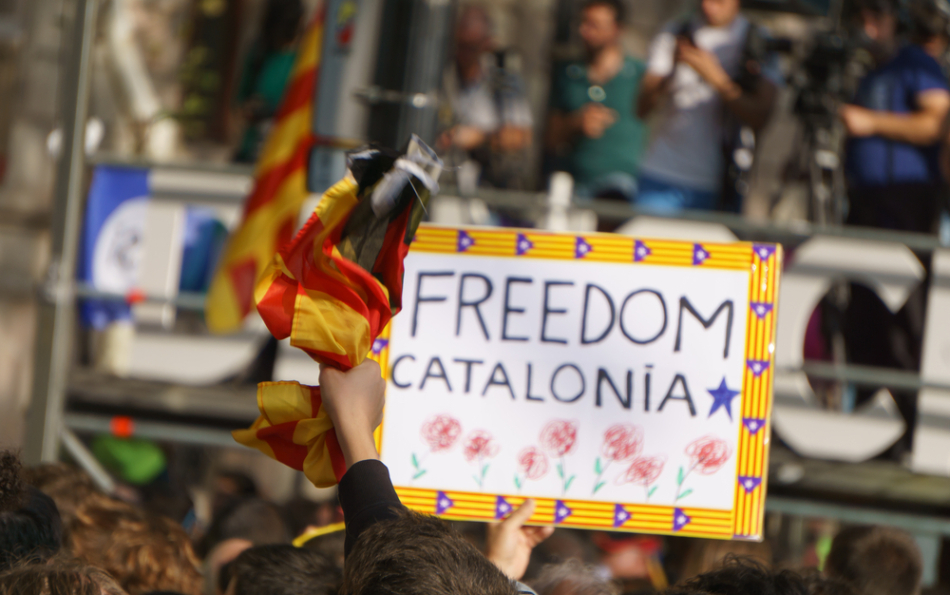
In the early nineteenth century, Catalan separatism experienced a renaissance. In 1922, the first political organisation advocating the region’s independence appeared: Estat Català (“Catalan State”). Activists led by Francesc Macià sought to create a country that would also include Catalan lands belonging to France. In 1928, a constitutional assembly of Catalan separatism took place in Cuba, where participants adopted a constitution for an independent Catalonia. The estelada — the unofficial flag of the Catalan lands and the principal symbol of independence supporters — was also adopted at that time. The most that could be achieved in those years, however, was the official recognition of Catalonia as an autonomous region (this occurred in 1932, during the dictatorship of General Primo de Rivera).
Then came another dark period for Catalans: the dictatorship of General Francisco Franco (1939–75). Pursuing the concept of a maximally centralised state, the Spanish authorities suppressed the Catalan language and, more broadly, any manifestations of Catalan identity. As with everything connected to Francoism, this remains a subject of debate. There is another viewpoint according to which Catalan, while not flourishing, was not outlawed either.
What happened to Catalonia in democratic Spain?
Franco’s death in 1975 and the adoption of Spain’s new constitution in 1978 brought Catalonia relief. The region regained its autonomous status; Catalonia was recognised as a “historically constituted nation”; and Catalan received official status alongside Spanish.
Until the early 2000s, the leading forces in the region were moderate nationalist parties. The Catalan leader from 1980 to 2003, Jordi Pujol, followed the principle of peix al cove (roughly equivalent to “A bird in the hand is worth two in the bush”). He argued for a gradual expansion of autonomy through negotiations with Madrid.
In the early 2000s, more ambitious figures replaced the cautious nationalists. The new leader, Artur Mas, secured the adoption in 2006 of a new Statute of Autonomy for Catalonia — a key document that expanded the region’s powers (including in education, culture, language policy, taxation, and transport). Catalans were recognised as a separate nation. But in 2010, Spain’s Constitutional Court removed several of the most contentious provisions — in particular, it ruled that the legal recognition of Catalonia as a “nation” was impermissible. This triggered mass protests and pushed the region towards open separatism.
In 2014, the Catalan authorities held a non-binding consultation in which 80.76 per cent of participants supported independence (although turnout was 37.1 per cent).
The climax came on 1 October 2017. The Catalan authorities held an independence referendum in which 90.2 per cent of participants backed secession (turnout 43 per cent). The Catalan parliament then proclaimed independence. The central government categorically rejected the referendum’s legitimacy, used force to block polling stations, then invoked Article 155 of the constitution (imposing direct rule on the region) and launched criminal proceedings against separatist leaders. The head of the regional government at the time, Carles Puigdemont, avoided punishment: he fled to Belgium and remained at liberty.
Background
Catalonia is one of Spain’s 17 autonomous communities, but it enjoys broader powers than most of them. Along with Galicia and the Basque Country, it is among the so-called “historic autonomies” — regions that had their own models of self-government during the Second Republic (1931–39). Their special rights were recognised under the post-Franco constitution of 1978. Andalusia also managed to obtain expanded autonomy.
Catalonia has its own institutions of government (the highest self-governing body, encompassing both parliament and executive, is known as the Generalitat) and its own police force (the Mossos d’Esquadra). Catalonia’s autonomous status is set out in its Statute — a kind of mini-constitution for the region, specifying its powers. It grants the Catalan authorities the right to regulate key areas of domestic policy independently — those relating, for example, to education, healthcare, culture, and language. Thus, the Catalan government designs curricula, funds medical institutions, determines cultural policy aimed at preserving Catalan identity, and promotes the use of the Catalan language.
Other autonomous communities also have statutes, and their content differs significantly. For example, the Basque Country has its own tax system separate from the national one — a markedly higher level of autonomy than Catalonia’s (while Galicia’s competencies are far more limited). At the same time, Catalonia’s Statute sets out a mechanism for bilateral negotiations with Spain’s central authorities. In the Basque Country, similar commissions cover far fewer areas, and Galicia has no such mechanism at all.
In all cases, however, spheres such as defence and foreign policy remain under the jurisdiction of Spain’s central government.
What motivates supporters of independence?
Independence supporters emphasise the region’s long history of political self-government, including centuries of its own governing institutions and legal system. In their view, independence would restore historical justice.
Another argument is a distinct cultural and linguistic identity. Nationalists believe it is necessary to protect Catalan uniqueness more actively; in their deep conviction, Catalans have little in common with the rest of Spain.
Catalonia is one of Spain’s most developed and wealthiest regions: in 2024 it produced about 19 per cent of Spain’s total GDP. Moreover, the Catalan economy grew faster (3.6 per cent in 2024) than the national average (3.2 per cent). At the same time, a significant share of taxes collected in the region flows to the central budget and is then redistributed in favour of less developed autonomous communities. Independence supporters consider this system unfair.
They also invoke the right of peoples to self-determination enshrined in the UN Charter. “Why are the Scots and the residents of Canada’s Quebec allowed to hold independence referendums, but we are not?” they ask.
Another argument is the results of the 2014 and 2017 votes, where an overwhelming majority of participants supported independence.
What are the arguments of supporters of a united Spain?
The main argument is Spain’s Constitution, which refers to the “indissoluble unity of the Spanish Nation, the common and indivisible homeland of all Spaniards”. The country’s fundamental law does not provide a procedure for a region to secede by its own will. As in such cases generally, the right to national self-determination conflicts with the principle of territorial integrity.
The referendums were not conducted in accordance with international standards, and turnout does not allow one to claim that a majority of Catalans has ever supported independence.
Catalan society is deeply divided on the question of independence. Secession without clear consensus could provoke serious internal conflict and undermine social stability.
Hopes of economic prosperity, experts argue, are unfounded. An independent Catalonia would not automatically receive EU membership. This would entail customs duties, reduced investment, disrupted supply chains, falling exports, rising unemployment, and other problems. Analysts estimate that Catalonia would lose a fifth of its GDP simply through the transition to becoming an independent state.
So is the Catalan independence movement dead now?
2017 was clearly the peak of independence enthusiasm. For example, in March of that year 44.3 per cent of Catalonia’s residents supported independence while 48.5 per cent were against it. The referendum led to no practical outcomes, and support for radical steps has steadily declined ever since. In February–March 2025, 37.6 per cent of Catalonia’s residents supported independence while 54.1 per cent were opposed.
The shift in mood was also influenced by the fact that, instead of the People’s Party — advocates of hard-line approaches — the Socialists came to power in Spain. In May 2024, the Spanish parliament adopted an amnesty law for Catalan separatists. In August of the same year, Catalonia came to be led by the Socialist Salvador Illa, who returned to the peix al cove tactic.
For example, the Catalan leader is pushing for Catalan to become an official language of the EU. In addition, he is developing and implementing measures to increase the active use of the language within the region itself. The National Pact for Language, agreed in May 2025 includes more than 200 proposals and objectives. Its implementation through to 2030 is expected to cost at least €200 million annually.
On 11 September 2024, only 60,000 people took part in the Diada march — the lowest figure in a decade. By comparison, in 2014 some 1.8 million people took to Barcelona’s streets. But this does not mean that the independence movement is dead. Catalan separatism operates in cycles, like tides — and a new surge remains possible. Escalation could occur, for instance, if Spain’s government is once again formed by the People’s Party. Or, even more so, if the ultra-right Vox gains greater influence in national politics.
For now, supporters of radical steps have gone quiet and are waiting for the right moment. As reported in May this year, they even have 6,500 ballot boxes ready: they were ordered as reserves for the 2017 referendum and have been stored ever since in a warehouse in southern France. Activists are convinced these ballot boxes will still be used.
Related Articles
—
Why Feeding Kids in Spain Means Surrendering to Sugar — A Russian Mum's View from Valencia
At the playground, treats fly between families faster than you can track them, and restaurant kids' menus rarely stretch beyond chips and nuggets. But after years in Valencia, one mother is rethinking what really matters.
Spain's "Watergate": How the Leire Díez Case Is Threatening Pedro Sánchez
A former PSOE activist nicknamed "the plumber" is accused of running a shadow operation to sway court cases involving the party. With "El One" appearing throughout her messages, the opposition is circling
Andalusia Votes Right: What the Regional Election Results Mean for Spain's 2027 General Election
The People's Party won 41.6% but fell short of a majority, handing Vox the decisive role in forming a government. Healthcare and housing dominated the campaign — and both issues will be central in 2027
Why Is Spain So Corrupt? A Brief History and Eight Reasons the Problem Won't Go Away
With parliamentary elections approaching, corruption has become Spain's hottest political weapon. But the phenomenon is neither new nor simple — it stretches back centuries and involves structural, cultural, and psychological factors that no government has yet managed to fix.
The Cross and the Smartphone: The Paradoxes of Spanish Faith in the 21st Century
As Spain secularises at record speed, a new "cool Catholicism" led by influencers and pop stars like Rosalía is reinventing ancient traditions for the Gen Z era
Can You Cut Off Utilities to "Okupas"? Spain’s Supreme Court Sets Crucial Legal Boundary
While cutting off water and electricity to illegal squatters is ruled legal, the court warns that using the same tactic against a divorcing spouse remains a punishable crime
Valencia Unveils Free Nature Guide Featuring 69 Stunning Water Routes
From free open-air screens at major town squares to indoor mega-venues like the Roig Arena and Movistar Arena, here is the complete guide to catching Sunday's historic final live
Beyond Paella: Discovering All i Pebre, Valencia’s Best-Kept Culinary Secret
Deep in the heart of the Albufera wetlands, the fishing village of El Palmar preserves a traditional, rich garlic and wild eel stew that tourist traps completely miss
Historic Milestone: The Gibraltar Border Fence is Down as Schengen Integration Begins
A new era dawns for the Campo de Gibraltar region as a temporary EU-UK treaty takes effect, ending 117 years of physical separation and removing daily controls for 15,000 cross-border workers
The World Cup 2026 Final: Best Big Screens and Fan Zones in Valencia, Barcelona and Madrid
From massive public screenings at Roig Arena and beachfront hubs to open-air gardens and local cinemas—here is your ultimate guide to the best spots to watch the historic match in the Valencian Community