Blood and sand: what do spaniards think about corrida?
Share:
Collage: RinaLu for La Cotorra
“Spain is the only country where death is a national spectacle,” wrote the poet Federico García Lorca nearly a century ago, reflecting on bullfighting. Today, many Spaniards challenge that claim. Tauromachy — the ritualised fight with bulls — caught between old tradition and modern ethical standards. Now it is going through a turbulent moment.
According to sociologists, most people in Spain do not support this old tradition anymore. And yet attendance figures at the country’s most famous arena, Madrid’s Las Ventas, are hitting record highs. As a new bullfighting season gets underway and gathers pace, La Cotorra looks at how this controversial phenomenon emerged, how it evolved, and what the future may hold for it.
Shadows of ancestors
Bulls have always held an important place in the Iberian Peninsula. For the ancient Iberians and Celts, these animals were not merely a source of food, but also sacred symbols with profound religious significance. Traces of this cult can still be found across Spain. For example, the Bulls of Guisando in the province of Ávila: four stone sculptures made by the Celts before the 3rd century BC. At the time, the killing of a bull was considered a sacred ritual.
Under Roman rule, this tradition evolved into taurobolium, a ceremonial bull sacrifice, as well as staged fights with bulls in arenas. Over time, such events became an integral part of Roman Spain’s cultural life.
By the Middle Ages, bullfighting had firmly embedded itself in Spanish tradition, though in a very different form. Following the completion of the Reconquista, encounters with bulls became a pastime of the elite. Caballeros — knights on horseback — faced bulls in town squares, displaying bravery and skill at weddings, tournaments and major religious celebrations.
The first documented festival of bulls dates back to 1128, when it was staged to celebrate the wedding of King Alfonso VII of Castile. By the 16th century, every celebration included some form of bullfight, firmly cementing the spectacle as a central feature of public celebration.
A turning point came at the beginning of the 18th century, when Philip V of Spain became the first monarch of the Bourbon dynasty. Raised in France, the king regarded mounted bullfighting as barbaric and forbade nobility from organising bullfights. Paradoxically, this ban transformed bullfighting into a popular activity among common people rather than aristocrats. The spectacle became more democratic: ordinary people began facing a bull on foot, not on horseback.
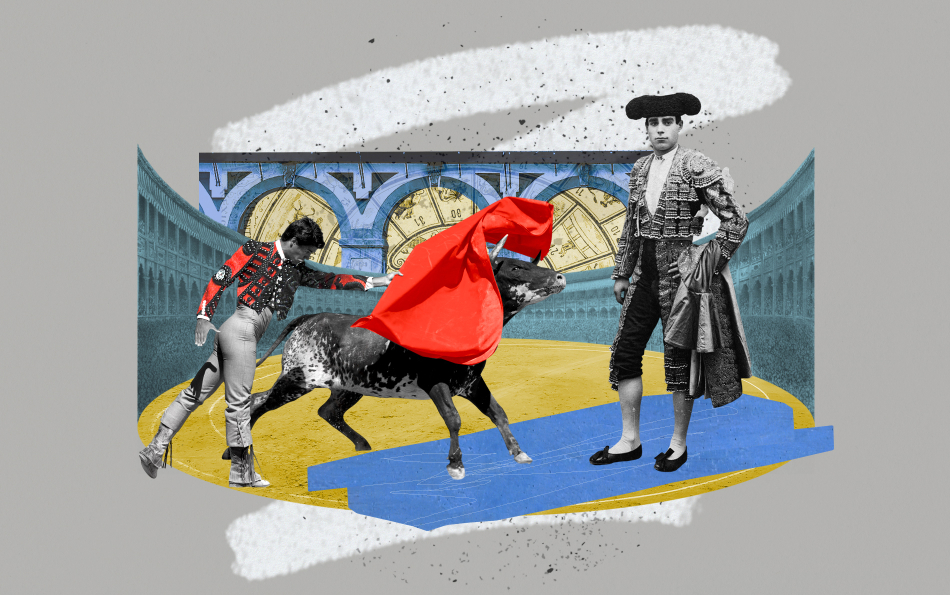
Modern bullfighting began in the town of Ronda, Andalusia. In 1726, a local torero, Francisco Romero, staged a quiet revolution in the art of tauromachy. He introduced the muleta — a small red cloth on a stick used to control the bull’s movements — and made the matador the central figure of the fight. In 1784, Ronda saw the construction of the first circular bullring, deliberately designed so the bull could not retreat into a corner.
The 19th century marked a period of codification. What had once been a chaotic blood sport began to shape as an art by the standards of the time. During this era, special breeds of fighting bulls were developed. These breeds stood out for their aggression and so-called bravery.
The “golden age” in the 1910s and 1920s was defined by two figures, Juan Belmonte and José Gómez Ortega. They pioneered a new style: a matador no longer ran from a bull but stood still, forcing the animal to circle him. This shift turned the corrida into what it is today: a slow, lethal dance between a man and a beast.
Even the Spanish Civil War failed to bring bullfighting to a halt. Fights continued on both sides of the front line: in Barcelona, they were organised in support of the Republic, while in Seville, they honoured the forces of Francisco Franco. After the war, the dictator actively supported thebullfights for propaganda, using them to project an image of a timeless, traditional Spain.
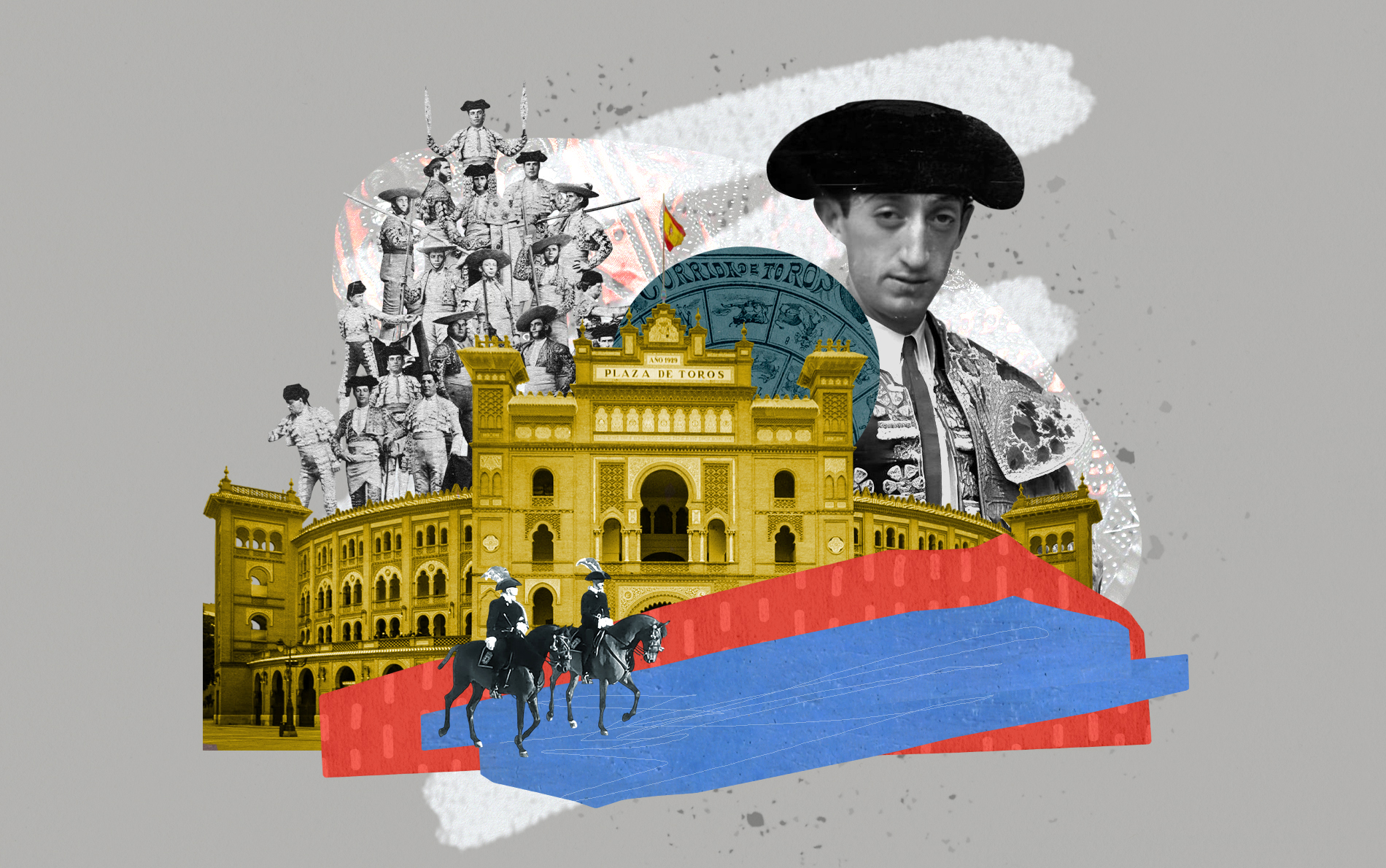
Manolete from Cordoba, who lived during that period, is the most famous matador of all time. He died in 1947 after being fatally gored by a bull during a fight. Such was his popularity that Franco declared three days of national mourning after his death.
Collage: RinaLu for La Cotorra
In the second half of the 20th century, the attention of the public was shifted from bullfighting to football. Yet reports of the corrida’s demise appear to be greatly exaggerated. At least for now.
Anatomy of the ritual
Spanish bullfighting is a ritual outcome of which is known in advance: the animal is doomed to die, and the man is meant to prevail. A typical corrida lasts around two hours and consists of six fights — two for each of the three matadors.
A matador does not face the bull alone. He has support from his cuadrilla, a small team that includes picadors — horsemen mounted on specially armoured horses — and banderilleros, assistants who work with capes and shoot barbed sticks, known as banderillas, into the bull.
Corrida opens with a parade of all participants. This is followed by three distinct acts, or tercios, which structure the fight from start to finish.
The first stage is the tercio de varas. The matador tests the bull’s character with the heavy cape, the capote. Through a series of passes, he assesses the animal’s speed and the direction of its charges. The picadors then enter the arena, thrusting their lances into the bull’s neck up to three times, both to gauge its strength and to weaken the muscles of the neck.
The second stage is the tercio de banderillas. One by one, three banderilleros run towards the bull and plant the banderillas into its shoulders. The aim is to provoke and enliven the animal, making it aggressive without exhausting it ahead of the final confrontation.
The final stage is the tercio de muerte. A matador is left alone with the bull and, through a sequence of highly stylised, almost choreographed passes, seeks to bend the animal entirely to his will. When it's time to finish the fight, a matador delivers the estocada — a sword thrust aimed precisely between the shoulder blades, intended to pierce the heart in a single, decisive move. If several attempts are needed, it is considered a disgrace.
Once the bull collapses, the arena president, usually the city’s mayor or another local official, evaluates a matador’s performance based on the crowd’s reaction. Spectators wave white handkerchiefs, calling for a reward.
The highest honour for a matador is the awarding of two ears and the bull’s tail. As for the bull itself, if it showed exceptional bravery, its body may be paraded around the arena to rapturous applause.
There is a greater honour: the indulto, or pardon. If a bull displays truly exceptional bravery, the arena president may order that its life be spared while the fight is still underway. Such an animal will never return to the ring and instead becomes a breeding bull on its ranch. This outcome is exceedingly rare: only around 0.1% of fights end this way. In 2024, fewer than a dozen such cases were recorded across Spain.
New season
The 2026 season got underway on 6 February at the fair in the small town of Valdemorillo, on the outskirts of Madrid. One of the biggest moments in the bullfighting calendar is now approaching: the Fallas fights in Valencia, scheduled for 7–17 March. In Madrid, the season starts in late March and builds towards its annual marathon, the San Isidro feria, running from 8 May to 6 June
Over the summer, the main events take place in the north of Pamplona, where the San Fermín festival, with the famous bull runs through the city streets, remains one of Spain’s biggest international draws for tourists. As usual, the season will end in Madrid with a corrida on Spain’s National Day, 12 October.
Across the country’s more than 600 arenas, regardless of temporary ones, hundreds of bullfights will take place. In 2024 alone, for example, there were 1,546 corridas. Even so, this represents only a small fraction of all events. That same year, 93% of them — 19,404 events — were devoted to popular festivals involving bulls: encierros (as in Pamplona), bous al carrer (the street runs typical of Valencia and Catalonia), and a host of other local traditions.
Corridas, however, are not held everywhere.
For example, corridas are banned in the Canary Islands, the only region in Spain to have introduced such a measure.
The ban was introduced back in 1991 under an autonomous animal protection law. That said, bullfighting never really took root on the islands in the first place. What ispermitted there are traditional cockfights — a local custom that has survived. In the rest of Spain, by contrast, except in Andalusia, cockfighting is banned.
Catalonia is another story. In 2010, the regional parliament outlawed bullfighting following a popular initiative, and the ban came into force in 2012. Four years later, Spain’s Constitutional Court overturned the decision, ruling that the region had overstepped its powers by infringing on Spanish “cultural heritage”. Even so, despite the legal green light, not a single traditional corrida has taken place in Catalonia since 2010: political will at the local level and public pressure have proved stronger than the court’s ruling.
The Balearic Islands followed a different path. In 2017, the regional parliament passed a law banning the use of pikes and banderillas, as well as the public killing of the bull, following the Portuguese model, where bulls are not killed in the ring. But in 2018, the Constitutional Court declared the law unconstitutional, and bullfighting on the islands promptly returned in its traditional form.
Pros and cons
The debate around bullfighting shows no sign of fading — and may never disappear. In Spain, books and essays continue to appear with titles such as “50 Theses in Defence of Bullfighting” — and for every argument put forward, a counterargument arises.
Supporters insist that corrida is far more than a spectacle: it is a centuries-old tradition and an inseparable part of Spain’s cultural identity. Opponents respond that tradition alone cannot justify cruelty. History is full of long-standing “customs”, from gladiatorial combat and stoning to female genital mutilation, that societies have ultimately rejected as unacceptable and unjust.
For one part of Spanish society, bullfighting is a form of art, a ritualised expression of risk, courage and grandeur, a symbolic victory of human reason over wild nature. Critics counter that art should be constructive and uplifting, and cannot be built on the deliberate infliction of physical suffering on a living being for the sake of public entertainment.
Supporters of bullfighting point to studies suggesting that the fighting bull has a unique hormonal response, allowing it to block pain in the heat of combat and convert stress into heightened aggression. Veterinarians strongly oppose this, arguing that a bull is a mammal with a highly developed nervous system and experiences extreme pain, fear and panic from the moment it is put onto a truck until the final thrust of the sword.
Defenders of corrida also claim that without bullfighting, the fighting bull breed (toro de lidia), maintained through generations of selective breeding, would simply disappear, as it is economically unviable under standard farming conditions. Animal rights activists counter that the fighting bull is not a separate biological species but the product of artificial selection for aggression, and that the disappearance of this “selective line” would not be a tragedy for biodiversity — especially when those animals suffer a lot.
Collage: RinaLu for La Cotorra
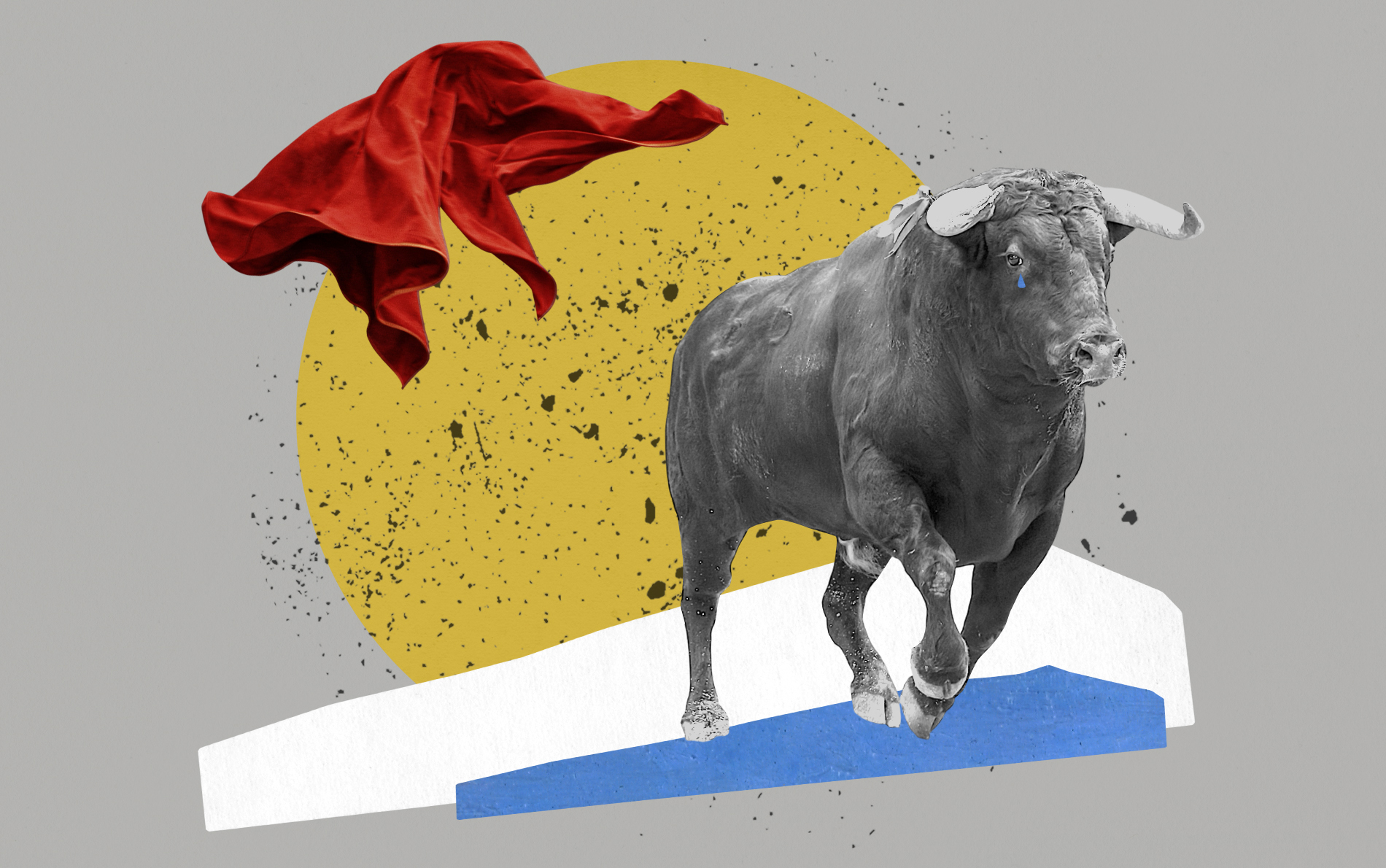
Bullfighting enthusiasts often stress what they see as the ethical “purity” of the duel, arguing that the real risk of death faced by a matador is a necessary condition that levels the playing field and distinguishes the ritual from mere slaughter or torture. On rare occasions, matadors do die: the most recent death occurred in 2016. Activists counter, quite reasonably, that the fight is unequal from the outset: by the final tercio, the bull is already exhausted and wounded by lances and banderillas, trapped in an enclosed arena with no possibility of escape.
As Ernest Hemingway once observed, “If bulls were allowed to gain experience as toreros do, if bulls that lasted fifteen minutes in the ring were not then killed behind the scenes but instead released to fight again, they would grind every matador to dust.” But bullfighting, of course, is not designed to allow for such a scenario.
Politically, defenders fall back on the argument of “cultural freedom”: those who dislike bullfighting are free not to attend, but should not forbid it for others. Critics respond that bullfighting is not a matter of personal taste, but an expression of cruelty and animal exploitation.
The economics of bullfighting
Economic arguments inevitably appear in the debate. The positive impact of bullfighting on the Spanish economy is estimated at €4.1 billion a year, directly supporting around 54,000 jobs. If related sectors are taken into account — tourism, logistics, costume-making and more — that figure could rise to as many as 300,000 jobs.
The primary sector is bull breeding. Spain has 840 registered farms housing more than 166,000 fighting bulls. Andalusia leads the way with 222 farms, followed by Castile and León (168) and Extremadura (103). These estates manage vast tracts of land — around 50,000 hectares — in economically fragile areas often referred to as “empty Spain”.
Another sector is meat processing. The tertiary sector covers the spectacles themselves and the tourism that grows around them. Annual VAT revenues from ticket sales alone amount to around €40 million, five times more than the Spanish film industry contributes to the state budget.
For example, Las Ventas in Madrid seats 23,800 spectators — the largest in Spain and the third largest in the world, behind only Mexico City and Valencia in Venezuela. Last season, Las Ventas broke records, welcoming more than one million spectators. In 2026, the arena’s management plans to surpass that figure by increasing the number of bullfights and attracting more tourists, who now make up the major audience for corridas in major cities.
Outside the big centres, the picture is very different. Average attendance at provincial arenas rarely exceeds 50 per cent of total capacity, and without public subsidies, many would be forced to close. In 2024, funding to support bullfighting was provided by 1,820 municipalities out of 8,000 across Spain.
Political rift
Meanwhile, a growing number of towns across Spain are declaring themselves “bullfight-free”. To date, dozens of municipalities have spoken out against hosting corridas. The main tool at the local level has been a financial boycott: town halls simply refuse to allocate public funds for staging bullfights, insuring events or maintaining arenas. Without this backing, bullfighting at the provincial level becomes unviable, leading to the closure of arenas.
Left parties usually run these municipalities. As with many other issues, bullfighting in Spain now sits along a clear political cleavage.
Figures on the left view corrida as a form of legalised torture. The hardest line stance comes from Sumar and Podemos, which call for an immediate end to all public funding for bullfighting and for the removal of its status as cultural heritage. In 2024, for example, Sumar member and culture minister Ernest Urtasun scrapped the National Bullfighting Prize. And on 30 January 2026, media reported that youth and children’s minister Sira Rego, a member of the Communist Party of Spain and also part of Sumar, intended to push for a ban on minors attending bullfights, arguing that exposure to them leads to a “desensitisation to the suffering of others or the normalisation of violence as a form of entertainment”.
Spain’s governing Socialist Workers’ Party (PSOE) has taken a more cautious approach, finding a balance between a rural electorate that values tradition and a more progressive urban majority.
Meanwhile, the conservative People’s Party (PP) and the far-right Vox have emerged as the main political defenders of corrida. For them, bullfighting is a symbol of “traditional Spain” and a core element of the country’s cultural heritage.
Vox also weaves bullfighting into its broader rhetoric about defending national sovereignty. In regions where these parties hold power, the sector is actively supported through systems of direct subsidies.
The balance of forces became particularly clear in the autumn of 2025. That year, activists of the campaign "No es mi cultura" (“This Is Not My Culture”) gathered more than 715,000 signatures calling for corrida to be denied its cultural heritage status. The initiative was submitted to Spain’s Congress of Deputies, but failed to pass: in the October vote, Sumar and Podemos backed the proposal, the PP and Vox voted against it, while the Socialists abstained, determining the outcome.
Love for animals against traditions
It would be wrong to assume that all PP and Vox voters are supporters of bullfighting. A survey conducted by polling agency Sigma Dos in 2025 showed that 78 per cent of Spaniards do not consider themselves fans of corrida. Among voters, bullfighting finds support from 37.6 per cent of the Vox electorate, 31.3 per cent of People’s Party voters, 10.2 per cent of Socialists and just 4.2 per cent of those who back Sumar.
Overall, 48 per cent of respondents said bullfighting should be denied its official status as cultural heritage, while 39.5 per cent were against the measure. The remaining respondents could not decide. From this, the centre-right newspaper El Mundo concluded that “a significant part of society tolerates this tradition, even without deriving any pleasure from it”.
The most consistent opponents of corrida are young people aged between 18 and 29.
Gender also plays a significant role: women are far more likely to reject bullfighting than men.
Researchers link the declining interest in bullfighting to a broader rise in empathy towards animals among Spaniards: a shift reflected in a 2025 survey by the BBVA Foundation. A key factor in this change has been the widespread adoption of pets: during the COVID-19 pandemic, the number of animals living in Spanish households increased by 40 per cent.
The writer, Arturo Pérez-Reverte, described the transformation in one of his columns. As a child, he often went to bullfights with his grandfather, and later, as an adult, he continued to take an interest in them, seeing bullfighting as an expression of tradition. Over time, however, he changed his position:
:
«I think it began with my daughter. When she was eight, reading Moby-Dick, she said: ‘Dad, the poor whale.’ In that instant, I understood that the world was changing — and that a part of me was changing with it. My dogs also played their part; I’ve had five in total. I doubt that anyone who has lived side by side with them, felt their loyalty and devotion, and looked into their eyes, can remain indifferent to the suffering of an animal.».
At the same time, he says he still understands bullfighting enthusiasts and believes they have the right to defend what they love. “I simply stay out of it. I don’t go to bullfights — that’s all,” he wrote. By 2026, this quiet, hands-off stance appears to have become the most common position among Spaniards.
Related Articles
—
Why Feeding Kids in Spain Means Surrendering to Sugar — A Russian Mum's View from Valencia
At the playground, treats fly between families faster than you can track them, and restaurant kids' menus rarely stretch beyond chips and nuggets. But after years in Valencia, one mother is rethinking what really matters.
Spain's "Watergate": How the Leire Díez Case Is Threatening Pedro Sánchez
A former PSOE activist nicknamed "the plumber" is accused of running a shadow operation to sway court cases involving the party. With "El One" appearing throughout her messages, the opposition is circling
Andalusia Votes Right: What the Regional Election Results Mean for Spain's 2027 General Election
The People's Party won 41.6% but fell short of a majority, handing Vox the decisive role in forming a government. Healthcare and housing dominated the campaign — and both issues will be central in 2027
Why Is Spain So Corrupt? A Brief History and Eight Reasons the Problem Won't Go Away
With parliamentary elections approaching, corruption has become Spain's hottest political weapon. But the phenomenon is neither new nor simple — it stretches back centuries and involves structural, cultural, and psychological factors that no government has yet managed to fix.
The Cross and the Smartphone: The Paradoxes of Spanish Faith in the 21st Century
As Spain secularises at record speed, a new "cool Catholicism" led by influencers and pop stars like Rosalía is reinventing ancient traditions for the Gen Z era
Can You Cut Off Utilities to "Okupas"? Spain’s Supreme Court Sets Crucial Legal Boundary
While cutting off water and electricity to illegal squatters is ruled legal, the court warns that using the same tactic against a divorcing spouse remains a punishable crime
Valencia Unveils Free Nature Guide Featuring 69 Stunning Water Routes
From free open-air screens at major town squares to indoor mega-venues like the Roig Arena and Movistar Arena, here is the complete guide to catching Sunday's historic final live
Beyond Paella: Discovering All i Pebre, Valencia’s Best-Kept Culinary Secret
Deep in the heart of the Albufera wetlands, the fishing village of El Palmar preserves a traditional, rich garlic and wild eel stew that tourist traps completely miss
Historic Milestone: The Gibraltar Border Fence is Down as Schengen Integration Begins
A new era dawns for the Campo de Gibraltar region as a temporary EU-UK treaty takes effect, ending 117 years of physical separation and removing daily controls for 15,000 cross-border workers
The World Cup 2026 Final: Best Big Screens and Fan Zones in Valencia, Barcelona and Madrid
From massive public screenings at Roig Arena and beachfront hubs to open-air gardens and local cinemas—here is your ultimate guide to the best spots to watch the historic match in the Valencian Community