Support La Cotorra on Patreon
Access exclusive content, special perks, and closer connection with us.
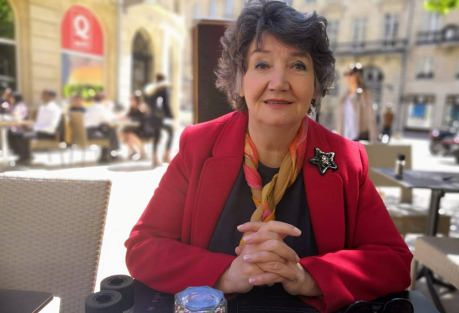
My name is Sofia. I was born in the notorious Minsk district of Chizhovka, Belarus, and I am a fallera. When I arrived in Valencia back in the distant year of 2013, everything here was different. I remember shuttered shops and worried Valencians discussing the financial crisis (as usual, these discussions mostly took place in packed restaurants over bottles of Rioja). I also remember flats for fourteen thousand euros, including taxes, and a great, great deal of dog mess in the streets.
And the festival.
It descended on the city like a multicoloured cloud of toxic paint. Enormous figures, a good half of which violated roughly every law in “our countries”. Bold, vivid, offensive to every feeling you might allow yourself to possess, occasionally indecent – the figures shouted, spoke, argued. They looked like an inner language, the city’s private code, which I immediately wanted to learn to read. Noise. Chaotic bursts of firecrackers. Danger. Joy. Spring. Bonfires in the streets, mountains of rubbish – all of it frightened me, outraged me, and enchanted me to the point of goosebumps.
There was nothing here that resembled the city festivals I thought I was used to.
“Come and join us, we make a very good paella,” said our estate agent, Cuca. He was a convinced socialist and had decided to extend a hand of friendship to the slightly wild Slavic immigrants.
At that time, my Spanish contained only the bare minimum of words, but fortunately, “thank you” was among them.
That is how we first stepped into the casal – a small premises on our street where, among historical photographs, the prizes of our falla, honorary ribbons and commemorative trophies, stood simple tables at which sat roughly all our neighbours. And the children of our neighbours. And the grandparents of the children of our neighbours. And now we as well.
A few times, we simply joined their meals, and then we were invited to become members of the falla.
By that point, I already understood that within Valencia, there exists an enormous secret world called Las Fallas, on which much of the city’s internal organisation rests. But I had doubts.
I was born in the Soviet Union, and my very first requests addressed to supernatural beings were directed to a portrait of young Lenin. It hung on the wall near my grandmother’s bookcase: curly-haired, printed on paper, slightly worn, and for a while it served me as something like an icon. To him I promised to be a good girl, and from him I asked admission to the Young Octobrists. Some of this was even granted, so the connection did, broadly speaking, exist.
Later, in the 1990s, I made numerous approaches to religion. Messiahs of every possible variety wandered the streets, promising eternal life, visas to the United States, and other advantages. Baptists, Pentecostals, the “White Brotherhood” – almost every organisation showed a particular interest in teenagers.
They all offered me a “new family”, and each one required baptism. Thus, I, secretly baptised by my mother in an Orthodox church in defiance of my father, a political officer, proceeded to be baptised again as a Baptist, as a Pentecostal, and the Lord alone knows into which other denominations. The film Life of Pi essentially tells the story of my childhood.
Later, I grew up and returned to more traditional forms of religion, aside from a brief flirtation with yoga, tarot cards, and UFOs. After all that, I had a fairly clear understanding that Catholicism might be one religion too many.
“It would be very strange to dress myself up in someone else’s costume and attach myself to someone else’s religion, which I do not even understand,” I told my husband. “It is surely terribly disrespectful to local customs. One should either be Catholic or have grown up in this culture to join a falla.”
But before I had finished speaking, our socialist Cuca was already approaching me.
“You may think that one has to be Catholic, or to have grown up in our culture, to join our falla,” he said, as though he understood Russian. “But we have completely non-believing people here. Atheists. And Jorge here has recently taken an interest in Buddhism. It is not necessary at all to be religious. They simply like being here, being with us, and that is enough.”
A month later, we were already having outrageously expensive dresses sewn in a local workshop. By a curious coincidence, it was owned by a lady from Rostov. Previously, she had sewn historical costumes for a drama theatre.
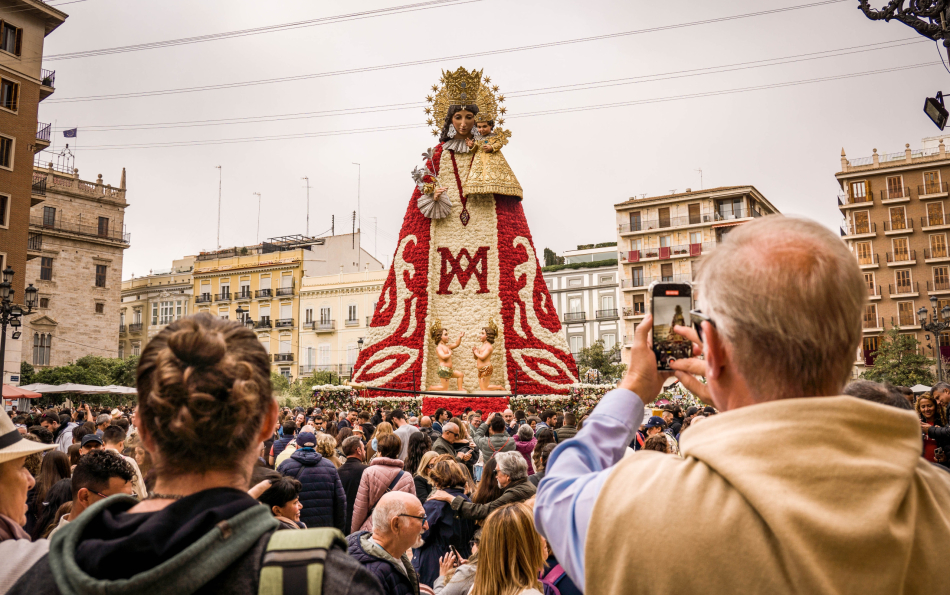
In 2022, I walked through the entire city in full dress in a column of my neighbours: the shopkeepers, plumbers, estate agents, teachers and pensioners of my street. I knew them, and they knew me. It was raining, and the already heavy skirt of my dress gradually soaked through until it weighed what felt like a ton. To stop it slipping down I had to hold it with both hands. In my head, there were a hundred hairpins, barely holding the borrowed braids in my thin Slavic hair. Huge traditional earrings swung from my ears – earrings I would never have chosen to wear on my own.
The procession through the city took several hours. My textile shoes became soaked and fell apart as we approached the Virgin Mary. During the final kilometre, I cried continuously into my tightly packed bouquet of white carnations, which smelled intoxicatingly strong and filled the streets with their scent.
I was overwhelmed with emotions I had never known before.
I handed over the bouquet, and it became one of the tiny dots on the mantle of the Virgin Mary, Our Lady of the Forsaken.
I asked for peace, peace, peace – I truly did ask for it.
I do not think that all of this made me a Catholic. But I certainly became a real fallera after that Ofrenda.
Related Articles
Beyond Paella: Discovering All i Pebre, Valencia’s Best-Kept Culinary Secret
Deep in the heart of the Albufera wetlands, the fishing village of El Palmar preserves a traditional, rich garlic and wild eel stew that tourist traps completely miss
Loading…
Loading…