


Support La Cotorra on Patreon
Access exclusive content, special perks, and closer connection with us.
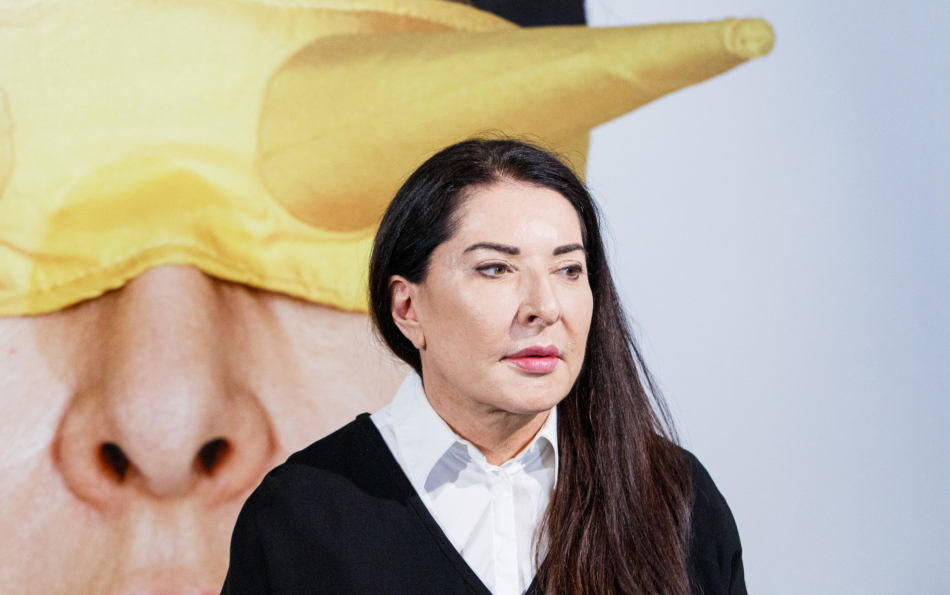
Marina Abramović, a long-standing and undisputed legend of performance art, brought her new production entitled Balkan Erotic Epic, to Barcelona. It is dedicated to the body — its memory of recent and forgotten historical events, its ability to reproduce, its desire for life and fertility, as well as death, both close and completely foreign. Rejecting contemporary notions of indecency, Abramović reminds the viewer what it is like to feel one's body again in an era of progress and established social norms. La Cotorra tells how it was.
Marina Abramović calls Balkan Erotic Epic the most ambitious work of her career. It premiered in 2025 in Manchester, England, where they built what was almost a small town for the performance. Barcelona was next in line — for five days at the end of January 2026, the production could be seen on the stage of one of Spain's most major theatres, the Liceu.
Balkan Erotic Epic is clearly multidisciplinary — the action takes place on the theatre stage, but it is not a theatrical play in the general sense. It unfolds within frequently changing, meticulously designed sets, partly against a backdrop of video sketches, which duplicate what is happening on stage or replace what cannot be depicted on stage, and also includes dance, song, narrative and performative elements.
Balkan Erotic Epic begins not on stage, but in the theatre foye where the audience is greeted by an orchestra accompanied by the strict mother of the artist Danica Abramović, whose military bearing is both frightening and, as is often the case with frightening things, eye-catching (this is probably the most noticeable role in the entire production, which lacks a unified narrative line).
After spending some time outside the hall, the orchestra finally enters the theatre's main stage, where the funeral of Josip Broz Tito, the long-time president of Yugoslavia, is taking place. Shortly after his death, Yugoslavia ceased to exist and plunged into an incredibly brutal war that lasted for many years. His portrait and suit hang on the stage. Danica places a bouquet of red carnations next to Tito's portrait. At this moment, we see professional mourners on the screen, women in black headscarves and dresses, rhythmically beating their chests.
The figure of the mother is central to this performance, as it is to almost any discussion of the subconscious and the physical.
Danica Abramović was a communist, a partisan heroine during World War II (she was credited with saving dozens of lives), an army major and director of the Museum of Revolution and Art in Belgrade. Marina Abramović and Balkan Erotic Epic have repeatedly spoken about her incredible strictness and conservatism in raising children — for example, until the age of 29, the artist had to return home no later than 10 p.m.
It is difficult to imagine that a woman of such a temperament would not only refrain from suppressing any nascent interest in corporeality in her children, but would herself have any connection to sexuality at all. This feeling, however, soon ends — at some point, the action of Balkan Erotic Epic moves to a kafana, a Balkan tavern, where Danica, dancing on the table, gradually takes off her strict jacket with medals hanging on it and her long grey pencil skirt, loosens her tightly gathered hair and remains only in a satin shirt. In this state, she is guided by two drunk men — a little earlier, they tried to help her undress, for which they immediately received a slap from her. Watching the dishevelled, heated and out-of-control Danica, one inevitably thinks that she personifies the country in its difficult periods of life.
Another character in Balkan Erotic Epic, a scientist named Elke, helps to bring sexuality into the open. She is a narrator who can undoubtedly be trusted. She recounts myths, rituals and traditions that took place many centuries ago in the Balkans (one of the traditions, however, originated in Turkey) — among them, for example, recipes for love potions made from menstrual blood and rituals for preserving male fertility.
All these stories are connected with fertility and sexuality. One of them, perhaps the most notable, is a guide to what to do in case of prolonged rain. Elke says that in such situations, in order to save the harvest, women would go out into the fields, lift their skirts and show their vaginas to the gods — to scare them and stop the storm.
After telling this story, Elke gives the stage to women in traditional dresses and aprons who reenact the ritual: gathering under the pouring rain, they begin to move chaotically across the stage, screaming loudly, as if in labour, lifting their skirts and striking poses in which their genitals are most visible from above. Resonating with the previous scenes, which directly refer to the traumas of war and death (‘Dance with Knives’), this scene hints at how difficult it can be to give life, both to crops and to humans. And, of course, it tells of the power of female nature, capable of taming the elements and turning to the gods.
Then, on stage, visualisations of other rituals follow one another: a ‘black wedding’ takes place, where a girl is married to a deceased young man, a song about how the Slavic soul finds no understanding anywhere, and then an eroticised dance of completely naked people with skeletons.
In the finale of the final scene, set in winter and accompanied by snow, huge figures and the ringing of bells that shepherds used to carry to ward off evil forces from their flocks, Abramovich herself appears.
The scene is called ‘Dance of the Ancestors’ — as the name suggests, it is dedicated to the inseparable, invisible and yet all-pervading connection with ancestors, and the ringing of bells, in addition to warding off curses, symbolises both the expulsion of winter and the celebration of the changing seasons.
In the modern world, Abramović writes in the announcement to the performance, there is ‘great confusion between eroticism and pornography.’
Today's political correctness condemns erotic practices, even considering their content. In the past, for many ancient cultures, the continuation of the family line and life itself were based on numerous ceremonies that awakened awareness of the fact of our existence. I want to go back to the 9th–10th centuries and trace the development of these practices up to the present day. By rediscovering this forgotten past, I would like to create a new interpretation and a new context for a modern audience," says the artist.
Nudity, therefore, in Balkan Erotic Epic is not so much provocative (generally speaking, it is quite difficult to provoke a wide audience with nudity nowadays, but it is possible if placed in an extraordinary context) as it loudly and actively calls for a return from the world of puritanical progress to the earth and its origins to understand oneself and fully — perhaps for the first time in a long time — realise the fact of one's physical existence.
The production will also be on display at the Ruhr Triennial from 3 to 11 September 2026, in Berlin from 14 to 17 October, and in New York from 8 to 20 December.
Related Articles
Beyond Paella: Discovering All i Pebre, Valencia’s Best-Kept Culinary Secret
Deep in the heart of the Albufera wetlands, the fishing village of El Palmar preserves a traditional, rich garlic and wild eel stew that tourist traps completely miss
Loading…
Loading…