


Support La Cotorra on Patreon
Access exclusive content, special perks, and closer connection with us.
Choosing a school in Spain is never just a simple comparison of rankings or advice from parent group chats. For many international families, it is a question not only of educational quality but of the child's entire future lifestyle. Will they study in two languages simultaneously? Wear a uniform? Eat in the school canteen? How easily will they blend into the local environment, and how much will even "free" education actually cost the family? The choice is not between specific buildings, but between different systems of school life, adaptation paths, and future opportunities.
This is particularly evident in the Valencian Community, where Valencian, the second official language, can play a significant role even after graduation, when applying to public universities or seeking employment in the region. Private and international schools often offer a gentler adaptation and an environment more familiar to expats, but their graduates are sometimes less integrated into the Spanish system.
Before submitting documents, parents should decide: how long does the family intend to stay in Spain, how important is rapid integration, and which language should be the primary focus?
La Cotorra has prepared a guide to schools in Spain, collecting the essentials you need to know about different types of educational institutions, their costs, structure, and admission rules.
This is the most diverse school environment: no uniforms, no feeling of a closed system, and total immersion in the local context. Children who speak Spanish, Valencian, Romanian, Arabic, Hindi, or Romani at home study side-by-side. It is in these schools that a child most quickly encounters everyday life in Spain.
Public schools are considered free, and in terms of tuition, this is true. However, in practice, almost every family faces expenses that add up to a noticeable amount. Textbooks and materials can cost between €50 and €300 per year, the school canteen from €70 to €180 per month, and after-school or early morning care from €30 to €120. Consequently, even in a "free" school, monthly expenses often reach €100 or more.
Uniforms are usually not required, which slightly eases the start. However, a different challenge arises: the language.
In Valencia, some subjects are taught in Valencian, which often becomes a significant challenge for children who have moved recently.
While parents are still getting used to the new system, the child may already be bringing home math or social studies assignments in a language that no one in the family understands.
Admission to public schools is handled through a centralised distribution system. In the spring, parents submit an application listing several schools by priority, but the decisive factor is usually the place of residence. The closer the school is to home, the higher the chances. Other factors include whether siblings already attend the school and certain social criteria. If the chosen school is full, the child is offered another option within the district.
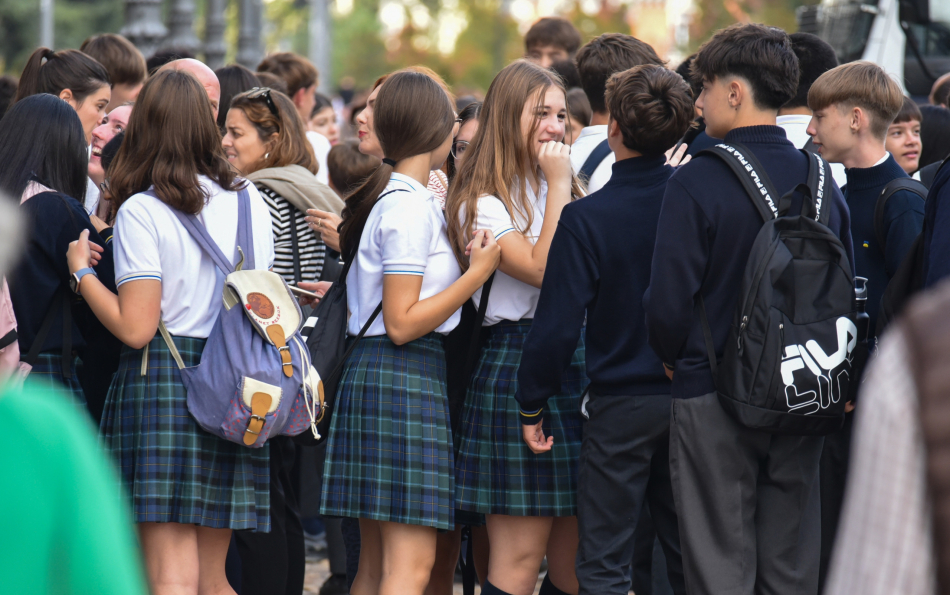
For many families, a Concertado is a compromise between a municipal and a private school. These schools more often require uniforms, have higher discipline standards, and offer a more structured school life.
Formally, tuition is also considered free because these schools receive government subsidies. But in practice, there are almost always regular payments: voluntary contributions, meals, extracurriculars, materials, and extended hours. On average, this can range from €150 to €400 per month per child. Uniforms are usually paid for separately, costing between €150 and €400 for a set.
Classes here may be smaller than in municipal schools, and school life tends to be more organised and tranquil.
Many semi-private schools have religious affiliations, which means religious holidays and participation in church life are part of a more traditional atmosphere. Valencian remains part of the curriculum, with some subjects taught in the language.
Admission follows the same state application system as public schools, but competition is typically higher. Priority is given to children living nearby and those with siblings already enrolled.
Private schools in Spain are usually chosen by families who prioritise comfort, predictability, and international prospects over local integration. These schools are a common choice for expats, especially those unsure of their long-term plans in the country. Many offer English-medium instruction or international programs (like the IB), designed for a smooth transition.
This is undoubtedly the most expensive option. Tuition typically starts at €500–€800 per month and can reach €2,000. However, the real budget is always higher due to meals, uniforms, registration fees, transport (as many are in the suburbs), and extracurriculars. Realistically, monthly expenses often start at €700.
Admission to private schools is handled directly through the administration. There is no residency requirement or centralised distribution. You simply apply, attend an interview, and pay the registration fee. International schools often have entrance exams, sometimes quite rigorous, requiring months of preparation.
Religious schools in Spain mostly exist within the Concertado system and are associated with a traditional, strictly organised environment. Parents choose them for various reasons: some seek shared values, while others are drawn to their reputation for discipline.
The curriculum includes religious studies, and the school calendar follows the liturgical year. The atmosphere is built around traditional ideas of authority and conduct. Costs are comparable to other Concertados, and admission depends on their status: through the state system if semi-private, or directly if private.
Single-sex schools remain a niche option chosen by families with specific views on upbringing. These are generally more conservative and private institutions where boys and girls are taught separately. They focus on academic excellence, discipline, and tradition.
The cost depends on whether the school is a Concertado or private, but it is rarely the most budget-friendly option.
Admission rules are standard for their type, though competition for places can be higher due to the limited number of such institutions.
In the Valencian Community, language is almost always the deciding factor. Education here is bilingual—sometimes trilingual—with lessons in Spanish, Valencian, and English. In some schools, even in subjects usually taught in Spanish, a teacher may switch to Valencian at their discretion.
Ultimately, every family seeks the right balance between integration, educational quality, language load, and budget. There is no universal "best" option—only the one that fits your specific child and family goals.
Related Articles
Why Feeding Kids in Spain Means Surrendering to Sugar — A Russian Mum's View from Valencia
At the playground, treats fly between families faster than you can track them, and restaurant kids' menus rarely stretch beyond chips and nuggets. But after years in Valencia, one mother is rethinking what really matters.
Emigrating with Kids: A Child Psychologist on Choosing Schools And Helping Teens Adapt
How do you pick a school after moving abroad? Do children really adapt so easily? La Cotorra asked child psychologist Svetlana Pron about everything from "I'm not going!" tantrums to bullying and withdrawn teenagers
Shakira Opens the 2026 World Cup at the Azteca — but a "Body Double" Theory Takes Over Social Media
The Colombian star performed "Dai Dai" with Burna Boy at the Mexico City opening, her fourth World Cup appearance. Within minutes, X users were asking whether it was really her on the pitch
Loading…
Loading…