

Support La Cotorra on Patreon
Access exclusive content, special perks, and closer connection with us.
From 6 to 12 June 2026, Pope Leo XIV (born Robert Francis Prevost) made his first trip to Europe since his election. For his visit, he chose Spain. It was the first visit by a pontiff to the country in almost 15 years, since the last visit by Benedict XVI in 2011, and the first papal visit during the reign of Felipe VI. The itinerary covered Madrid, Barcelona, Gran Canaria, and Tenerife. La Cotorra reports on the main moments of the Pope's visit.
The Pope is the head of the Catholic Church and at the same time the head of state of the Vatican, a sovereign enclave within Rome. For more than a billion Catholics around the world, he is the spiritual leader and successor of the Apostle Peter. At the same time, his role extends far beyond religion. The Pope acts as an influential figure in international diplomacy — heads of state receive him with a protocol comparable to a visit by the leader of another state, and his position on questions of war, migration, or human rights resonates even among those far removed from the church.
Spain is historically one of the most Catholic countries in Europe, although, like the whole continent, it is gradually becoming more secular. For this reason, a visit by the reigning Pope is an event that united not only believers: millions of people took to the streets, including those far removed from religious practice.
On 6 June, the Pope was met at Madrid-Barajas airport by King Felipe VI and Queen Letizia. Letizia wore a white dress — in keeping with the tradition under which Spanish queens have the right to receive the Pope in precisely this colour. She curtseyed and kissed the Pope's ring. After this, they set off for the Royal Palace, where the Pope was met by Princess Leonor and Infanta Sofía, dressed in black.
After the ceremony, the royal family and the Pope exchanged gifts. Among the gifts from the Spanish side were commemorative editions of the book De Mi Mano. Autógrafos de Isabel la Católica, a copy of the book "Maps of America in Spanish Books of the 16th–18th Centuries," a collection of three commemorative coins issued by the Royal Mint of Spain to mark the centenary of Gaudí's death, and a selection of Asturian products. Leo XIV presented a mosaic depicting the so-called Christ the Sun, created by the masters of the Vatican Mosaic Studio, and a commemorative medal of his apostolic journey.
During the drive through the streets of Madrid, a moment occurred that spread across social media. Responding to the crowd's greetings, the Pope unexpectedly made the "six-seven" gesture — an up-and-down movement of the hands that has gone viral on TikTok, as well as a phrase that has no specific meaning. "Six-seven" is often shouted as a joke or used as a vague answer to a question, something between "we'll see" and "maybe yes, maybe no."
The "six-seven" meme is believed to have originated from rapper Skrilla's track "Doot Doot (6-7)," where this combination is heard repeatedly in the chorus. Later the phrase was picked up by TikTok users making clips about NBA basketball players — in particular about LaMelo Ball, whose height is exactly 6 feet 7 inches (around 2 metres). A video of a teenager named Maverick Trevillian, who shouted "six-seven" with the characteristic gesture at a basketball game, gained particular popularity — after which he was nicknamed the "67 Kid."
The Pope's first stop was a migrant reception centre in Madrid's Lucero district. In the evening, 600,000 young pilgrims gathered on Plaza de Lima for a prayer vigil with the Pope. On the way to the square, the pontiff stopped the car several times to bless infants held out to him by their parents. Over two days in Madrid there were no fewer than eighty such blessings.
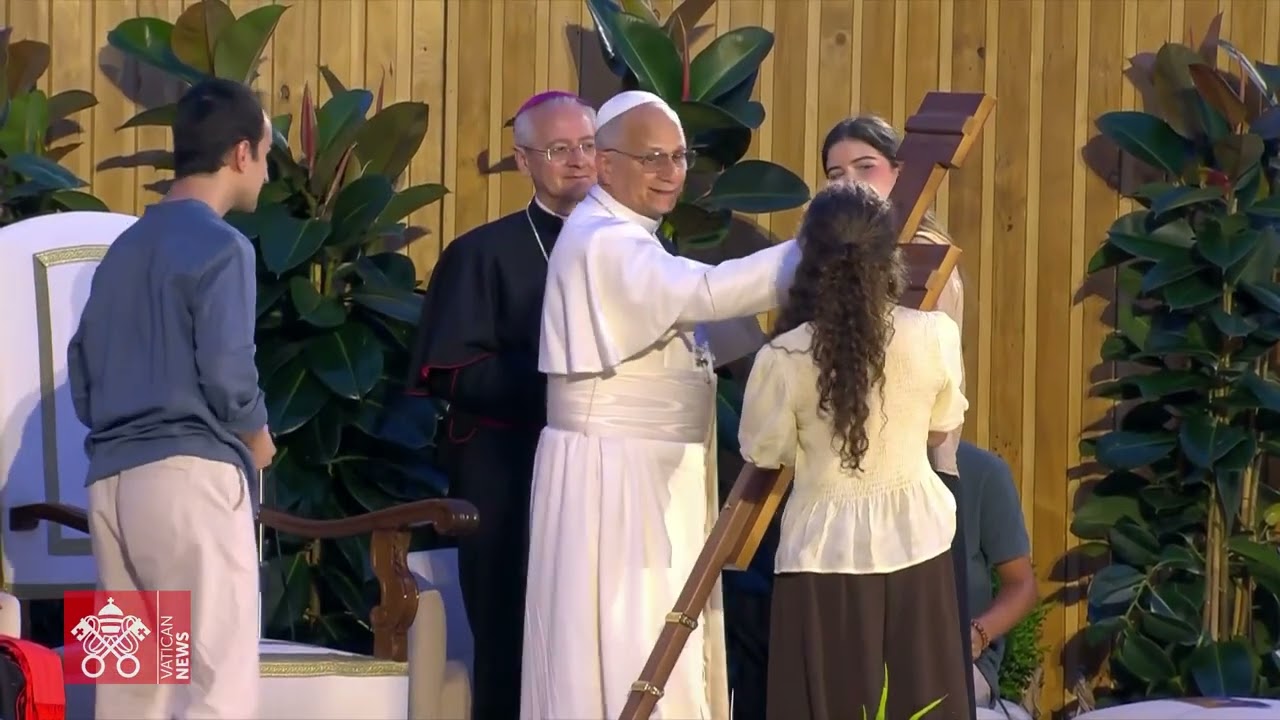
Sunday 7 June went down in history as the day of the most massive Corpus Christi Mass (the Feast of the Body and Blood of Christ) outside Italy — by various estimates, between 1.2 and 1.6 million people gathered on the Plaza de Cibeles and the surrounding streets. Before the Mass, the mayor of Madrid, José Luis Martínez-Almeida, presented the Pope with the Golden Key of the city, which Benedict XVI had also received in 2011. In return, Leo XIV left in the city hall's Book of Honour a wish that Madrid remain a hospitable city.
The altar for the Mass, a 600-square-metre structure with a five-metre figure of Christ, was designed by architects Cristina del Río Villegas and Concha Sánchez Maíllo. More than 150 bishops and cardinals and 1,600 priests took part in the liturgy. The Pope used a chalice commissioned by Queen María de las Mercedes of Spain from the jewellery house Ansorena in the 19th century. It was intended as a gift for the nuns of the Order of the Assumption of the Blessed Virgin Mary, at whose boarding school the Queen had studied. The relic, from the Almudena Cathedral, had never previously been used in worship.
After the Mass, Leo XIV carried the monstrance under a golden canopy over living flower carpets brought from Puenteareas in Galicia. More than 2,000 clergy distributed communion to the faithful along the route.
That same evening, at the Movistar Arena, the Pope met with representatives of culture, art, business, and sport. Among those present were well-known figures such as actor Antonio Banderas and Spanish badminton player and 2016 Olympic champion Carolina Marín.
The Pope became the first pontiff in history to address the Spanish parliament. Before him, Spain had been visited by John Paul II and Benedict XVI, but neither of them addressed the Congress of Deputies.
In his speech, Leo XIV noted that all legislative work ultimately runs up against a crucial question: "What conception of the human person underlies the laws, and what society do these laws build?" He added that Spain "knows how to see the human being not merely as a cog in the social, economic, or political machine."
"It recognises the human being as a creature open to truth, endowed with freedom and driven by a thirst for eternity that no temporal reality can quench," the Pope said.
In his view, "the protection of human life is not a party question, nor a confessional interest," but "a goal of civilisation." Every human life, he added, must be recognised and protected from the moment of conception to natural death. According to the Pope, the moral greatness of a nation is shown "in its capacity to accompany, protect, and love those lives that are most fragile."
Leo XIV warned of the deep spiritual and cultural crisis the world is experiencing. On the international stage, he explained, the world demands "diplomatic courage, ethical responsibility, and a vision of the future based on respect for the identity of each people," as well as "the duty of states to resolve their disputes by peaceful means." Weapons, the Pope warned, may impose a temporary silence, but they can never build a genuine and lasting peace.
After his address to parliament, Leo XIV held a private hour-long meeting with six victims of abuse by members of the clergy in Spain.
In the evening, at the Almudena Cathedral, Leo XIV presented a Golden Rose to the statue of the Virgin of the Almudena, patroness of Madrid. The ceremony was attended by Queen Sofía, who has personally met popes at least nine times.
The day ended at the Santiago Bernabéu stadium, where more than 70,000 people greeted the Pope with an ovation. Performing on stage were magician Jorge Blass, singer Diana Navarro, and singer David Bustamante.
On 9 June, Leo XIV flew to Barcelona. That same day, while still at the Cathedral of the Holy Cross and Saint Eulalia, the Pope held a solemn prayer and addressed the faithful who had filled the square outside the church, in Spanish and Catalan.
On the morning of 10 June, Leo XIV visited the "Brians-1" prison — the first time in history that a pope has visited a Spanish prison. He met with inmates and staff, saying that the past does not predetermine the future.
"Although hardship and sorrow may accompany some moments of your journey, remember that life's mistakes do not define a person's identity," Leo XIV noted.
The pontiff then set off for the monastery of Montserrat — a symbol of Catalan identity, where a twelfth-century Romanesque statue of the Black Madonna is kept. Here an amusing moment occurred. A young man named Sergi handed the Pope his rosary, hoping that he would bless it and give it back.
"I just wanted him to bless it, that's all, but he asked me, 'Is this for me?' And I wasn't going to say no, so of course I said yes, and he kept it," Sergi explained.
A few minutes later, the Pope took out the young man's rosary during prayer. Then Leo XIV got into the official car and drove off. Sergi started running after the car and shouting for the Pope to return the rosary, which he did.
In the evening, on the centenary of the death of Antoni Gaudí, Leo XIV, before the Mass at the Sagrada Família, visited the crypt, prayed at the architect's tomb, and lit a candle. After the liturgy, he ceremonially inaugurated the 172.5-metre-high Tower of Jesus Christ. The ceremony ended with a light show — hundreds of drones drew a portrait of Gaudí in the sky. La Cotorra reported on how the Pope consecrated the Sagrada Família's tallest tower.
On 11 June, Leo XIV arrived in Gran Canaria — the first papal visit in history to the archipelago. At the port of Arguineguín, the Pope met with migrants. He delivered a powerful speech in which he warned that "we cannot speak of dignity and allow the seas to turn into cemeteries." The visit ended with the consecration of a cross made from the wood of migrants' boats, erected in memory of those who died at sea.
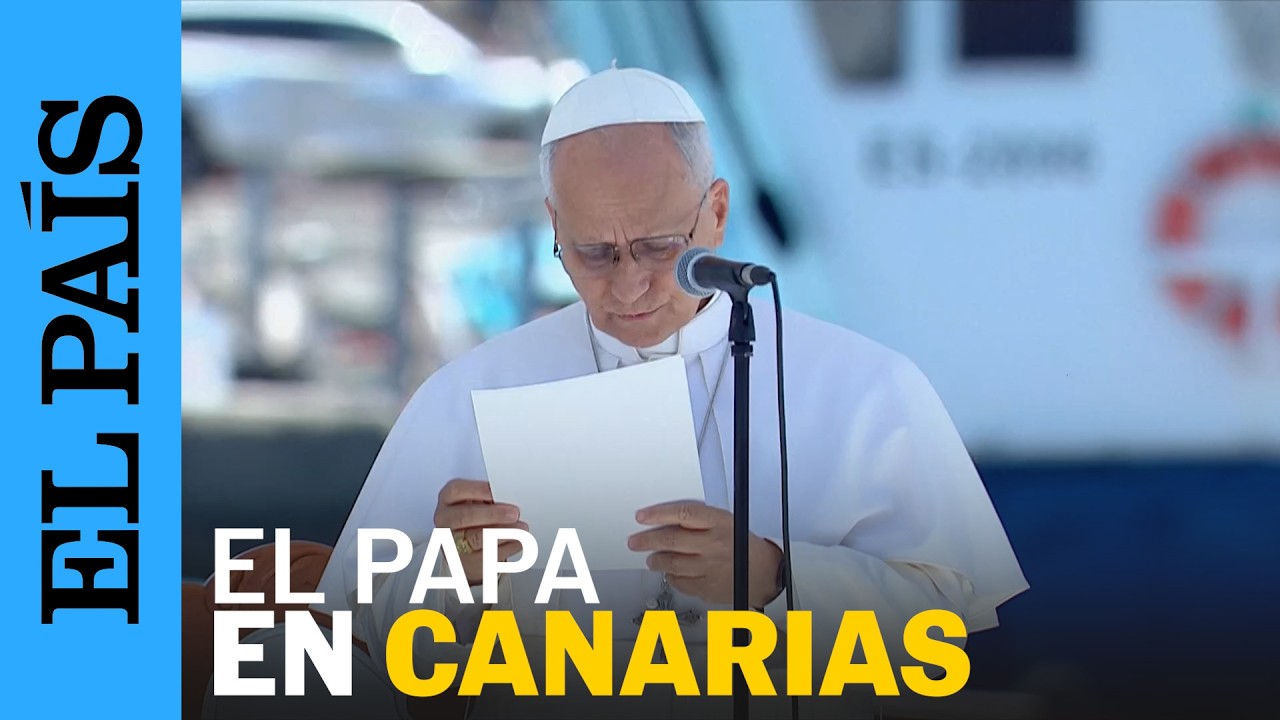
The mayor of Las Palmas de Gran Canaria, Carolina Darias, presented the Pope with the Golden Key of the city. Here Leo XIV held a Mass that drew around 50,000 of the faithful.
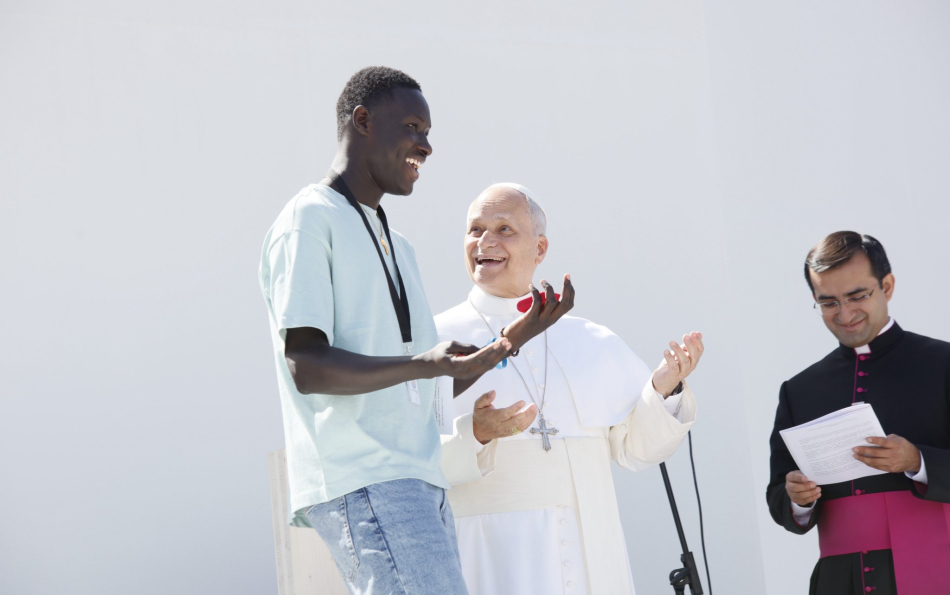
On 12 June, the last day of his visit, the Pope flew to Tenerife. In the morning he visited the Las Raíces refugee reception centre in La Laguna. Then Leo XIV went to the Plaza del Cristo in La Laguna to take part in an event dedicated to migrant integration initiatives. It was here that the Pope once again made the "six-seven" gesture, when 20-year-old Mbacke Ndiaye gave him a T-shirt and began to show the viral dance — Leo XIV happily repeated the gesture after him.

The morning ended with a grand religious ceremony marking the Pope's farewell to Spain, at the port of Santa Cruz de Tenerife, for around 40,000 people. In his speech, Leo XIV said that no person exists in isolation, and that "we are born for encounters, and there is no obstacle, distance, danger, or threat that could prevent each of us from making our journey."
At 4:30 PM, King Felipe VI personally arrived at the airport in Tenerife to see the Pope off. They spoke for about half an hour. A few minutes after boarding the plane, the Pope had to disembark — one of the engines failed to start.
To avoid a lengthy delay, Felipe VI offered the Pope his own Falcon aircraft. Two hours later, Leo XIV departed for Rome.
On 14 June, the Pope, after the "Angelus" prayer at the Vatican, thanked the Spanish people, who "received him with enthusiasm and devotion." He added that he was "especially grateful to His Majesty the King," and also wished "to pay loving tribute to the bishops, all the communities visited, and the entire Church that is in Spain."
Related Articles
First Designs for Valencia's 2027 Fallas Unveiled — a 20-Metre Nino Bravo to Crown the City
The main municipal falla on the Plaza del Ayuntamiento will feature a monumental figure of the Valencian singer under the slogan "Vuelvo a mi tierra," built entirely from eco-friendly material
Loading…
Loading…