





Support La Cotorra on Patreon
Access exclusive content, special perks, and closer connection with us.
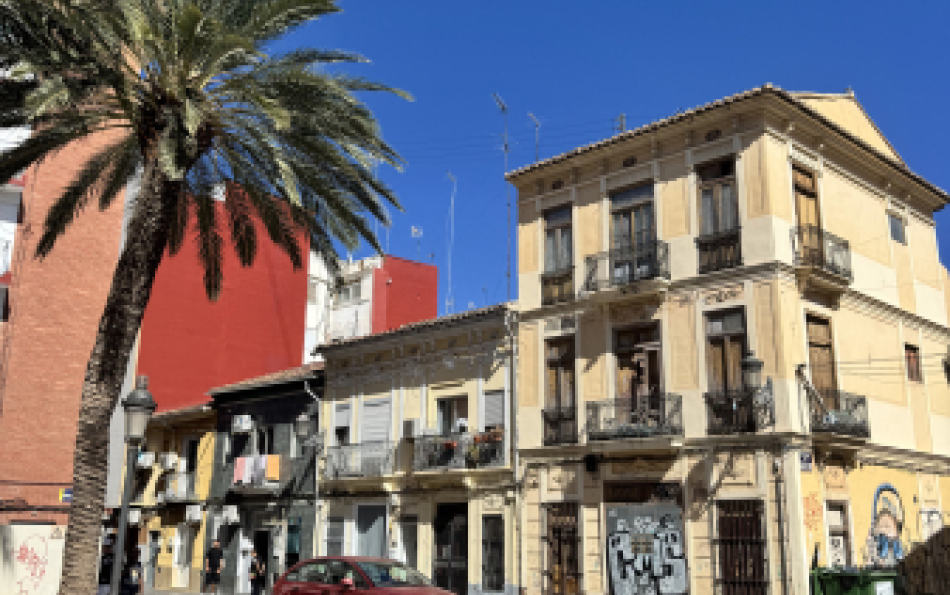
El Cabanyal is an old fishing quarter by the sea: narrow streets, houses with brightly coloured façades that invite you to linger, abundant graffiti, tiny authentic eateries, the oldest tavern in Valencia, and alleyways that even Valencians themselves sometimes describe as unsafe. Some people are eager to see it with their own eyes, while others advise keeping one’s distance. La Cotorra explored the history and contemporary identity of the district together with guide Valentina Krasheninnikova.
“There really is a completely unique atmosphere here. Cabanyal is very different from other historic districts of Valencia; beauty and decay merge here almost seamlessly. Yet recently there has been a growing demand for tours of Cabanyal,” Valentina says.
She aims to show this unusual coastal neighbourhood without gloss, exactly as it is: distinctive and artistic. Here, the beauty of carefully restored historic buildings stands beside ruins that have already become part of the district’s appearance.
The name of the neighbourhood comes from cabaña, meaning “hut”. These were the single-storey thatched houses in which fishermen lived. Originally it was a seaside village several kilometres from Valencia – large cities were traditionally built away from the sea and from pirates.
In the nineteenth century, coastal tourism began to flourish in Valencia, and wealthy families started building their splendid houses in Cabanyal. Ladies sheltered under white parasols would stroll by the sea to breathe the beneficial maritime air. These were the very scenes that captivated the celebrated Valencian painter Joaquín Sorolla. He depicted the two worlds of Cabanyal, separated by an invisible line: on one side poor fishermen and their families, and on the other Valencian aristocrats at leisure. A monument to Sorolla stands opposite the port, and the people of Cabanyal still consider the artist “one of their own”.
“When people come on this tour, they often expect cosy, neat, colourful little houses and charming cafés, but in reality it is quite different. Yes, Cabanyal has an abundance of beautiful architecture; traditional two-storey houses with ornate decoration line almost every street. But right next to them you may find a ruined façade or simply an empty plot where a building once stood,” Valentina explains.
In 1998, the authorities of Valencia decided to extend Avenida de Blasco Ibáñez towards the sea, cutting straight through the heart of the old quarter. To achieve this, significant parts of the historic buildings were slated for demolition – and some were indeed destroyed.
The neighbourhood began to fall into decline. Abandoned houses were taken over by squatters. Local residents then rose up in protest against the project, and even renowned Valencian street artists joined the movement to defend Cabanyal.
“There is a great deal of valuable graffiti here, some of it truly works of art. For instance, the mural of a mother with a child, symbolising the protection of the city’s history,” Valentina says, pointing to the vibrant artworks that now cover the walls of derelict buildings. One of the new symbols of the district is a spacious square created relatively recently to bring life back into the historic neighbourhood.
Here you will also find a working puppet theatre – a bright blue building adorned with traditional tiles that immediately catches the eye. Because of its proximity to the sea, humidity is higher here than in the city centre, and walls quickly develop mould. This is why residents often tiled their façades: the surface could be washed rather than repainted. Owing to the dampness, many houses also have entrances on both sides of the street, allowing rooms to be ventilated by the sea breeze.
Cabanyal is home to the oldest tavern in Valencia – Casa Montaña, founded in 1836. The sight of foreign tourists queueing outside an establishment amid such a patchwork of buildings is almost surreal. Owners of local shops openly play on this contrast, turning their boutiques and galleries into small adventures. Some places are accessible only by code; a completely blacked-out façade, for example, creates genuine intrigue: from the outside one can scarcely guess what lies within.
Today, Cabanyal is seeing the emergence of cultural centres, exhibition spaces, bars, and restaurants. There is even a bar that has been transformed into a music venue, located in the old ice warehouse La Fábrica de Hielo.
“I do not recommend that tourists begin their acquaintance with Valencia here; it truly cannot compete with the city centre. But for those who have lived here for many years, or were born here, such a tour is remarkably engaging. Even Spaniards come. Would I like to live here myself? Certainly not,” Valentina says.
Cabanyal is widely believed to have a star future ahead of it. Derelict and even openly unsafe corners of the neighbourhood have every chance of becoming new attractions.
Related Articles
Beyond Paella: Discovering All i Pebre, Valencia’s Best-Kept Culinary Secret
Deep in the heart of the Albufera wetlands, the fishing village of El Palmar preserves a traditional, rich garlic and wild eel stew that tourist traps completely miss
Loading…
Loading…