




Support La Cotorra on Patreon
Access exclusive content, special perks, and closer connection with us.
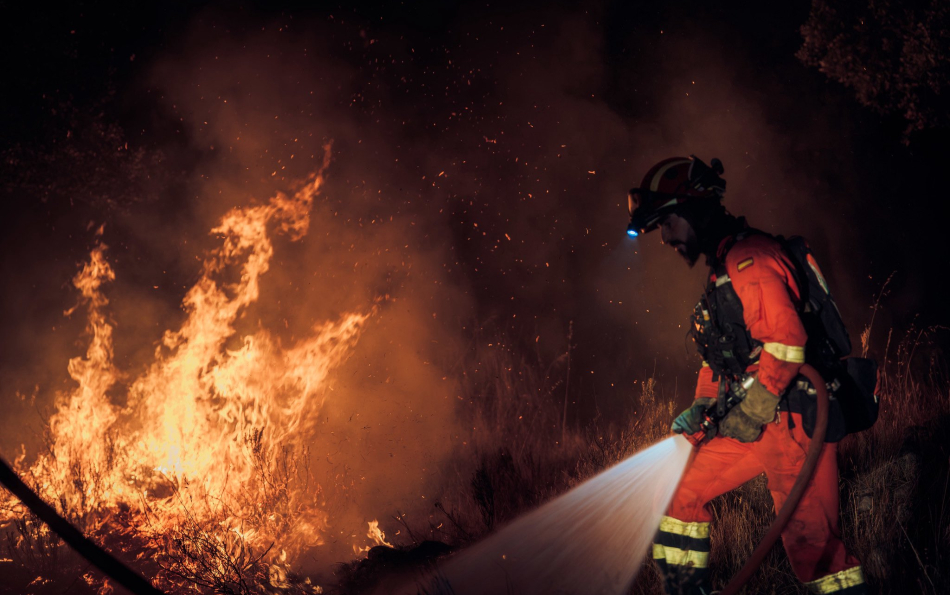
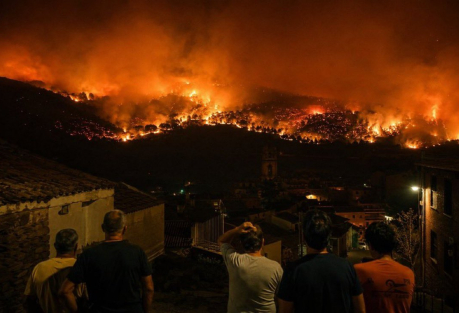
The wildfire that began near the town of Burgohondo in the province of Ávila has officially become the largest in Spain's recorded history. By the morning of Monday, July 27, the flames had destroyed approximately 50,000 hectares, with the fire perimeter stretching across 160 kilometers. “We are facing the most powerful and aggressive wildfire in the history of our country,” stated Interior Minister Fernando Grande-Marlaska.
Combined with active blazes in the Community of Madrid (over 25,000 hectares) and Toledo province (roughly 2,000 hectares), 77,000 hectares have burned across central Spain—reaching a total of 83,500 hectares when accounting for the wildfire in Castellón. Nearly 90,000 people across 46 towns in Madrid, Ávila, and Toledo have been evacuated or ordered to confine themselves indoors. In total, the fires have affected 65 municipalities and approximately 175,000 residents.
The wildfire in Madrid's Sierra Oeste is raging for its fourth consecutive day. The most challenging combat zones remain the surroundings of the Cofio River, the development of El Encinar del Alberche in Villa del Prado, and residential areas south of the San Juan Reservoir near San Martín de Valdeiglesias.
Overnight into Monday, shifting winds hindered firefighting operations in the Tiétar Valley in southern Ávila. The flames reached Santa María del Tiétar and closed in on Casillas from two flanks. Around 100 residents of Casillas remained in the town to protect their homes alongside firefighters, military emergency personnel (UME), and the Civil Guard.
According to Madrid Government Delegate Francisco Martín, the campsite in El Escorial—where 4,500 people had been evacuated—reopened on Monday. Residents of a nursing home in San Martín de Valdeiglesias have also been cleared to return, and bus services between Villamanta and Madrid are resuming. In total, regional authorities relocated 1,308 individuals from social care facilities during the emergency.
The origin of the Ávila wildfire was traced to a spark from heavy machinery operated in a prohibited area. The Civil Guard has arrested one individual and is investigating a second. The regional government of Castile and León intends to join the legal proceedings as a private prosecution.
The wildfire in La Vall d'Uixó (Castellón province), which began on Saturday around 11:00 AM, has entered its third day. By Monday, the blaze had scorched 6,500 hectares with a perimeter of 48 kilometers, encroaching on the Sierra de Espadán Natural Park.
A total of 16,000 people have been evacuated across 18 towns. Residents of La Vall d'Uixó, Onda, and Betxí (approximately 64,000 people) remain under shelter-in-place confinement orders. Nineteen individuals have required medical treatment for smoke inhalation. On Monday, firefighting efforts deployed 30 aircraft and over 450 personnel, half of whom are military emergency responders.
Technical command chief Antonio Rodrigo noted that stabilizing the fire might be achievable on Tuesday when relative humidity levels are projected to rise to 80%. Authorities are investigating the cause, with arson as the primary lead after three separate ignition points emerged within half an hour in a 500-meter radius. Spanish Prime Minister Pedro Sánchez is scheduled to visit La Vall d'Uixó on Monday alongside Valencian Regional President Juanfran Pérez Llorca.
On Sunday in Aldaia, brush fire reignited in abandoned fields near the Bonaire Shopping Center, reviving a flare-up from Saturday. Local police evacuated nearby homes before evacuating the shopping center and a hotel. The fire was declared under control by 5:20 PM.
That same day, a field caught fire along the Camí Nou del Salinar near an entrance to Valencia, adjacent to the Oceanogràfic aquarium. Although forest areas were spared, municipal authorities temporarily closed city access via the V-15 highway and halted local tram services.
Since the beginning of 2026, wildfires in Spain have destroyed over 150,000 hectares—six times the area burned during the same period last year. Smoke from the central blazes is visible on Meteosat satellite images, with smoke odor reaching as far as the Balearic Islands, prompting state weather agency AEMET to issue air quality warnings.
During a visit to the command center handling the wildfire in Los Gallardos (Almería), Prime Minister Pedro Sánchez reiterated calls for a comprehensive European pact to combat the climate crisis—a proposal he previously raised following the 2025 wildfires. The opposition People's Party (PP) rejected the initiative, proposing its own plan focused on enhanced forestry management, stricter penalties for arsonists, and a national registry for pyromaniacs.
Sánchez announced that the cabinet will officially declare the affected areas as zones severely impacted by a natural disaster emergency on Tuesday, unlocking state financial aid for those affected.
King Felipe VI and Queen Letizia of Spain visited evacuated residents in Villamanta, praising emergency workers and local citizens for their "exemplary coordination."
Related Articles
Spain’s First Flying Taxis to Take Flight in 2028 on Málaga–Marbella Route
Part of the EU-backed Verti-Go project, 15-minute electric air taxi flights costing €100 will connect Málaga and Marbella while testing airspace integration
Loading…
Loading…