



Support La Cotorra on Patreon
Access exclusive content, special perks, and closer connection with us.
Valencia's City of Arts and Sciences (Ciutat de les Arts i les Ciències) has unveiled its summer program. The main new additions are an interactive dance exhibition making its first appearance in Spain, a show built from mathematical fractals at the Hemisfèric, and free solar viewing through telescopes. Until September 6, the Science Museum is open longer than usual: from 10:00 AM to 9:00 PM.
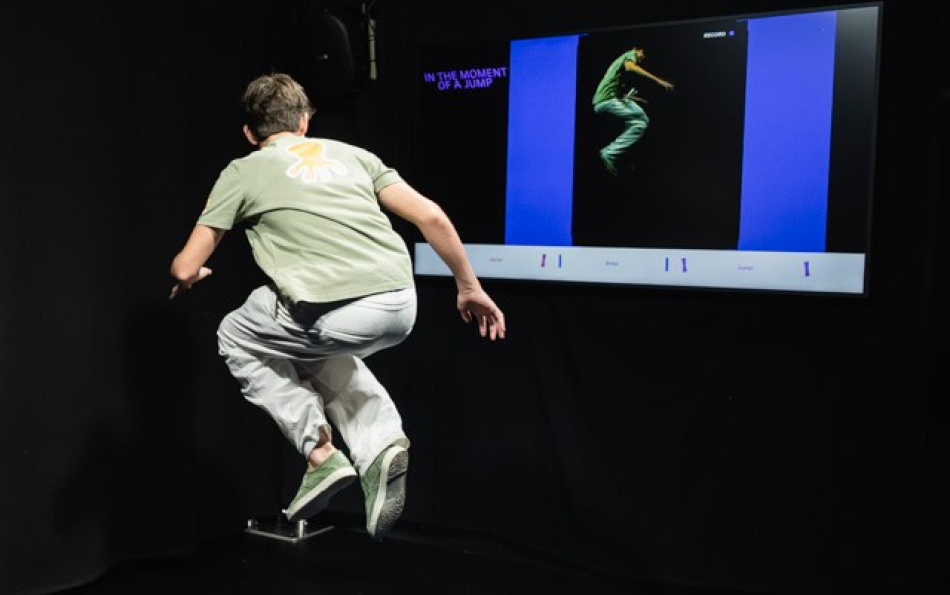
This summer's premiere at the Science Museum is the exhibition "Dance! The Art of Moving" (¡Bailar! El arte de moverse), making its first appearance in Spain. There's nothing to just look at here — you have to move: the exhibition responds to guests' movements and draws them into the experience.
Inside there are three zones. In the "Spin" zone, installations respond to body movements and introduce visitors to different dance styles. In the "Jump" zone, you can invent your own choreography, and cameras record your jumps so you can review them on screen. The "Encounter" zone has a "dancing carousel." Every half hour, it gathers everyone interested for a group dance, ranging from the branle (a Renaissance-era dance) to waltz and disco.
At the Hemisfèric, the cinema with a huge spherical screen, a new show has opened: Recombination. Más allá de la materia, by digital artist Julius Horsthuis. To experimental music, viewers are guided through five "universes" built from fractals — infinitely repeating mathematical patterns.
On August 12, a major solar eclipse will occur over Spain, and the complex is starting to prepare visitors in advance. On Tuesday, July 21, from 11:00 AM, telescopes will be set up in the square in front of the complex: anyone who wants to can view the sun, free of charge. At 7:00 PM that same day, a lecture on the upcoming eclipse will be given in the museum's auditorium.
The "Summer Night Sessions" (Las Nocturnas de verano) will also continue: on Tuesdays and Thursdays at 8:00 PM, an astronomer gives a live presentation of the summer sky beneath the planetarium's dome. Sessions run until September 3 (with an extra one on September 9) and are aimed at viewers over the age of ten. A documentary, "Eclipse. The Moment of Totality" (Eclipse. El momento de la totalidad), has been added to them as well — also part of the preparation for August's event.
The full program is available via this link.
This summer, children are shown films about dinosaurs, space, and the ocean. Tours and science experiments, "Science on Stage" (La Ciencia a Escena), take place every day, and the Science Theatre is putting on the musical Ramona y Cajal and a show about electricity, "High Voltage" (Alto voltaje).
The permanent exhibitions are also open — on transformations in nature ("Metamorphoses"), Mars, weightlessness, the Moon, and genetics ("Forest of Chromosomes"). And in the open air outside the complex, eight large sculptures in marble, steel, and granite have gone up — a new exhibition by the Korean artist Park Eun-sun, "Genome and Sculptural Structure." Details here.
Related Articles
Spain Beat Portugal 1-0 to Reach the World Cup Quarterfinals
A stoppage-time goal from substitute Mikel Merino sent Spain through in Cristiano Ronaldo's final World Cup match, echoing a 1-0 win over Portugal 16 years ago
Loading…
Loading…